


The Ultimate Dental Implants Guide: Types, Bridges, Bone Grafting & Full-Arch Solutions
Dental implants are one of the most reliable and natural-looking ways to replace missing teeth.
But for many patients, the options can feel confusing: How many teeth can one implant support? What is All-on-4? Do I need a sinus lift or bone graft?
This guide explains everything you need to know about dental implants, in clear, simple terms — so you can make informed decisions with confidence.
🔑 Key Takeaways About Dental Implants in Tenerife
Dental implants may seem complex, but the key ideas are actually very simple:
Dental implants replace missing tooth roots, allowing crowns, bridges, or full arches of teeth to be fixed securely in place.
One implant usually supports one tooth, but multiple teeth can be supported safely using implant bridges or full-arch solutions.
More teeth require more implants to keep chewing forces balanced and implants healthy long-term.
All-on-4, All-on-6, and All-on-8 are fixed solutions that replace a full arch of teeth using a carefully planned number of implants.
Hybrid implant prostheses are fixed, not removable at home — only the dentist removes them for maintenance.
Bone grafting and sinus lifts are common and routine, used when natural bone isn’t sufficient for implant stability.
Healing time is essential — implants need time to fuse with the bone to be strong and long-lasting.
Temporary teeth are usually provided, so patients are not left without a smile during treatment.
If you’re unsure which option applies to you, a consultation and 3D scan allow your dentist to recommend the safest and most predictable solution.
What are dental implants?
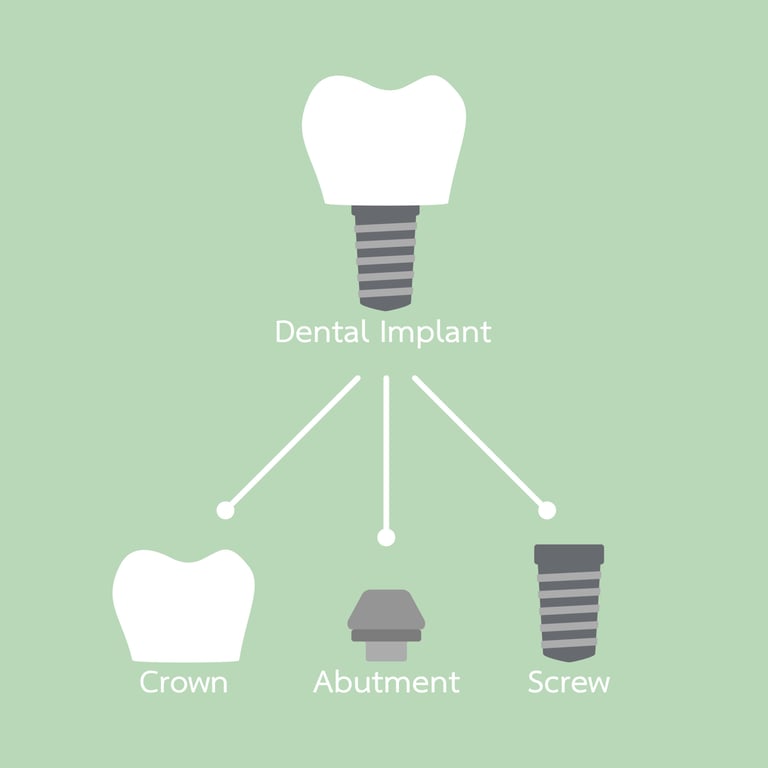
Dental implants are titanium or ziconia/ceramic made screws that are replacements for roots, carefully placed into the jawbone in areas where teeth are missing. These implants function as substitutes for the dental roots. The jawbone fuses with the titanium, forming a solid foundation for artificial teeth. Once the implants are ready to be restored, small abutments are placed, serving as firm anchors for the replacement teeth. Additionally, implants help preserve facial structure by preventing the bone loss that occurs when teeth are missing.
Once the implant screw integrates with the bone, it can support:
A single crown
A bridge (multiple teeth)
A full arch of teeth
Think of it as a strong foundation for new teeth.
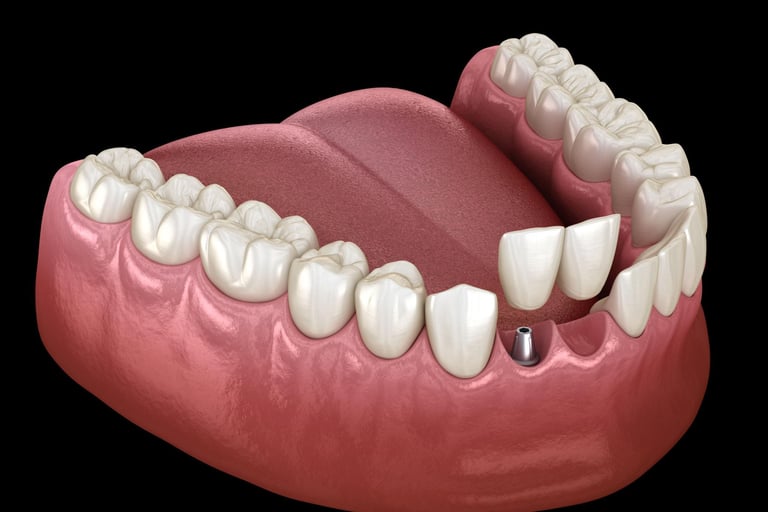
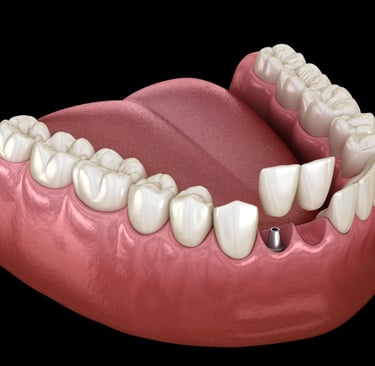
Single Dental Implant (One Implant, One Tooth)
This is the simplest and most common implant treatment.
Best for:
Replacing one missing tooth
Preserving healthy neighbouring teeth
Benefits:
Looks and feels natural
No damage to adjacent teeth
Very high long-term success rate
👉 Rule: 1 implant supports 1 crown.
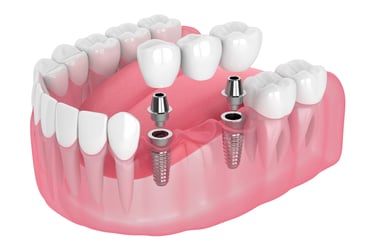
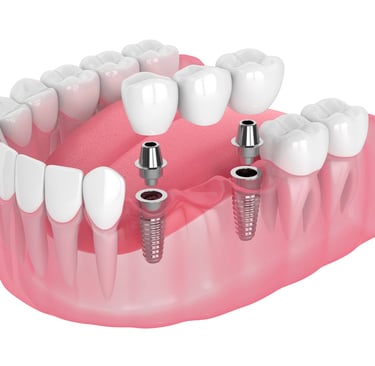
Implant-Supported Bridges (Multiple Teeth on Implants)
When several teeth are missing side-by-side, implants can support a fixed bridge instead of replacing every tooth with an implant.
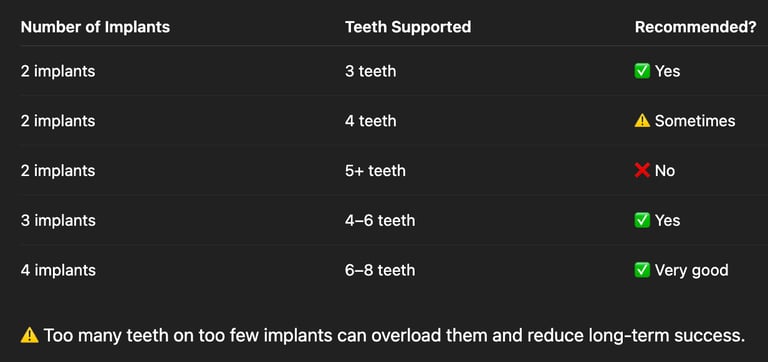
How Many Teeth Can Implants Support?
This depends on bone quality, bite force, and implant position.
General guidelines per side of the mouth:
Cantilever Implant Bridges (Teeth Hanging Past Implants)
A cantilever means a tooth extends beyond the last implant.
When used:
Limited space
Aesthetic areas with low bite force
Important limits:
Usually max 1 cantilever tooth
Avoided in heavy-chewing areas
Your dentist will only recommend this when it’s safe.
Full-Arch Dental Implants (All-on-4, All-on-6, All-on-8)
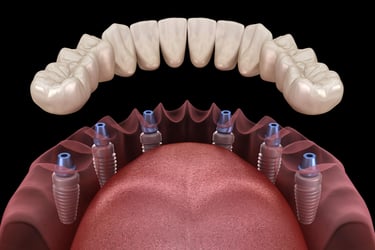
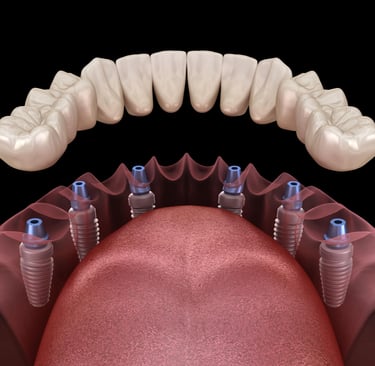
These treatments replace all teeth in one jaw using a fixed bridge supported by implants.
All-on-4 Dental Implants
4 implants support a full arch (10–12 teeth)
Often avoids bone grafting
Teeth are fixed (not removable by the patient)
Best for:
Patients with bone loss
Faster treatment timelines
All-on-6 Dental Implants
6 implants for better force distribution
Stronger long-term solution
Ideal for younger patients or strong bites
All-on-8 Dental Implants
8 implants for maximum support
Used when bone is excellent
Highest stability, highest cost
What Is a Hybrid Implant Prosthesis?
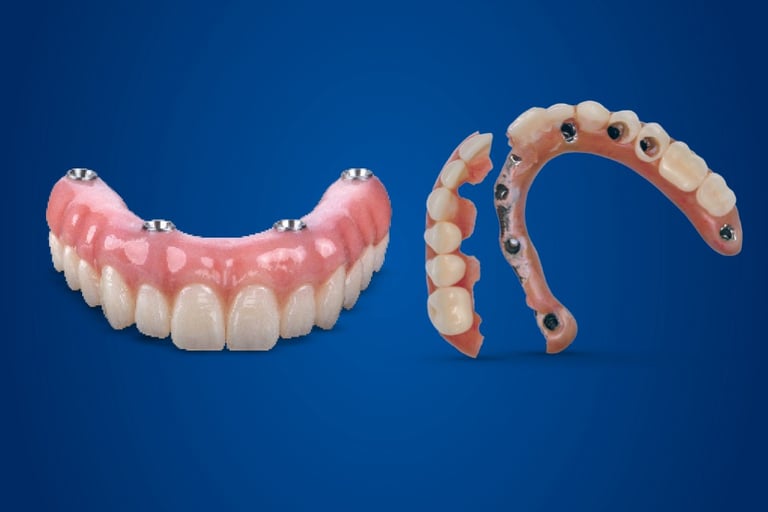
A hybrid prosthesis is a fixed bridge screwed onto implants, usually used for full-arch cases.
Made of:
Titanium framework
Acrylic or composite teeth
Artificial gum section
✅ Fixed (only removed by the dentist)
❌ Not removable at home
Implant-Supported Removable Dentures (Overdentures)
These dentures clip onto implants but can be removed daily by the patient.
Typically:
2–4 implants
More stable than normal dentures
Best for:
Elderly patients
Lower budgets
Easier cleaning needs
When Is Bone Grafting Needed for Dental Implants?
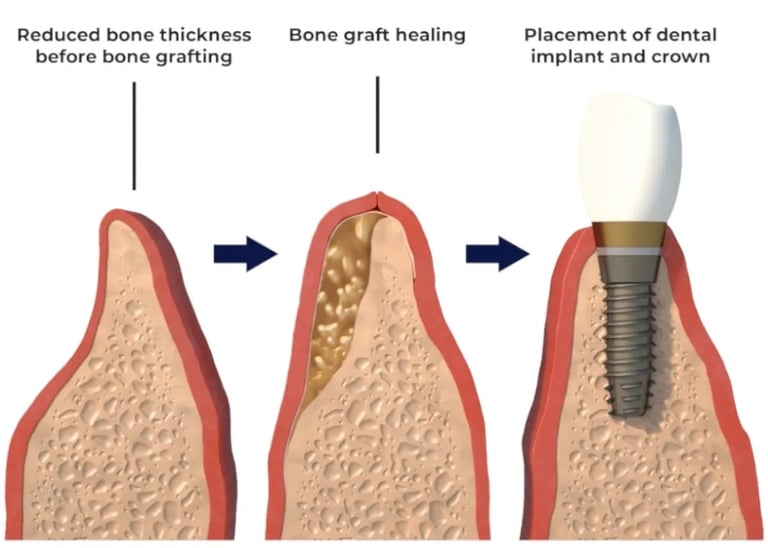
Dental implants need enough bone to stay secure.
If bone has shrunk after tooth loss or infection, it may need rebuilding.
Minor Bone Grafting
Small defects
Done at the same time as implant placement
Major Bone Grafting
Severe bone loss
Graft first, implant placed later
Healing: 4–6 months
🦴 Bone graft material helps your body regrow its own bone over time.
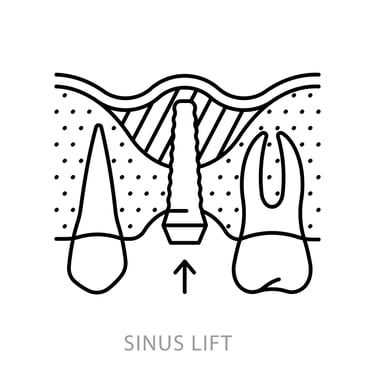
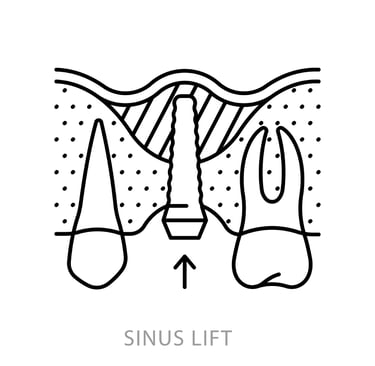
Sinus Lifts for Upper Back Teeth
In the upper jaw, the sinus can limit implant placement.
Internal Sinus Lift
Small lift (1–3 mm)
Implant often placed same day
External (Lateral) Sinus Lift
Used when bone is very thin
May require healing before implant placement
Both are routine and predictable procedures.
Dental Implant Healing & Timeline
Healing time depends on the procedure.
Implant only: 3 months
Implant + minor graft: 3–4 months
Sinus lift: 4–6 months
Major bone graft: 4–6 months before implant
Temporary teeth are usually provided, so you’re never left without a smile.
Are Dental Implants Right for You?
Dental implants are suitable for most adults — even those who’ve been told they “don’t have enough bone.”
A proper consultation with 3D imaging allows your dentist to recommend the safest and most long-lasting option for your situation.
📩 Book a Consultation
If you’re considering dental implants and want a clear, honest treatment plan, book a consultation to discuss your options and timelines.
Also, for Irish patients, we can also fill out your MED2 form so that you can claim back up to 20% on non-routine dental care that you get done with us (Crowns, implants, bone regeneration, etc.) from revenue's tax relief scheme. We are also happy to do this for visitors from other countries too, if such schemes exist in their country.
For patients traveling from the UK, we are not aware of a similar scheme but we can provide itemized invoices so that you can try to claim back off of your insurance, if possible.
❓ Dental Implants: Frequently Asked Questions
How many teeth can one dental implant support?
In most cases, one implant supports one tooth.
However, in implant bridges, two or more implants can safely support multiple connected teeth, depending on bone quality and bite force.
Can two implants really support five or six teeth?
Sometimes — but not always safely.
While three or four teeth on two implants is common, supporting five or more teeth usually requires additional implants to avoid overloading and long-term complications.
What is the difference between All-on-4 and All-on-6 dental implants?
Both replace a full arch of teeth with a fixed bridge.
All-on-4: fewer implants, faster treatment, suitable for reduced bone
All-on-6: more implants, better force distribution, often longer-lasting
Your dentist will recommend the option that best suits your bone, bite, and lifestyle.
Are All-on-4 teeth removable?
No.
All-on-4 teeth are fixed and cannot be removed by the patient. They are only removed by the dentist for professional maintenance.
What is a hybrid implant prosthesis?
A hybrid prosthesis is a fixed bridge made of a strong internal framework with artificial teeth and gums, screwed onto dental implants.
Despite the name, it is not a removable denture.
What is the difference between fixed teeth and removable implant dentures?
Fixed implant teeth: stay in place at all times; removed only by the dentist
Implant-supported dentures (overdentures): clip on and off and are removed daily by the patient
Both are stable, but fixed teeth feel closer to natural teeth.
Will I need a bone graft before dental implants?
Not always.
Many patients have enough bone already. Bone grafting is only recommended if it improves implant stability and long-term success.
What is a sinus lift and why is it needed?
A sinus lift is a procedure used in the upper back jaw to create enough bone height for implants when the sinus sits too low.
It is a routine and predictable part of implant dentistry.
Is bone graft material safe?
Yes. Bone graft materials are highly regulated and designed to help your body grow its own natural bone over time. They are not organ transplants.
How long does dental implant treatment take?
It depends on the case:
Simple implants: around 3 months
Implants with grafting or sinus lift: 4–6 months
Full-arch treatments may include immediate temporary teeth
Your dentist will explain the exact timeline before treatment begins.
Will I be without teeth during treatment?
No.
In most cases, temporary teeth are provided, ensuring you can smile, speak, and eat comfortably while healing.
Redes Sociales
Business hours
Contact
info@clinicadentalraices.es
© 2024. All rights reserved.
Monday 11:00 - 19:00
Tuesday 11:00 - 15:00
Wednesday 9:00 - 19:00
Thursday 9:00 - 19:00
Friday 11:00 - 15:00
Saturday 10:00 - 14:00 (Bookings)
Sunday Closed
Av. José González Fortes, 18,
Los Gigantes, Santiago Del Teide,
S.C. De Tenerife

+34 642301437 / +34 822643816